
www.intralogisticsmag.com
03
'26
Written on Modified on
Rethinking Fire Safety in Automated Warehouses
TGW explores how storage architecture and power distribution can influence fire exposure, suppression access and operational continuity.
www.tgw-group.com
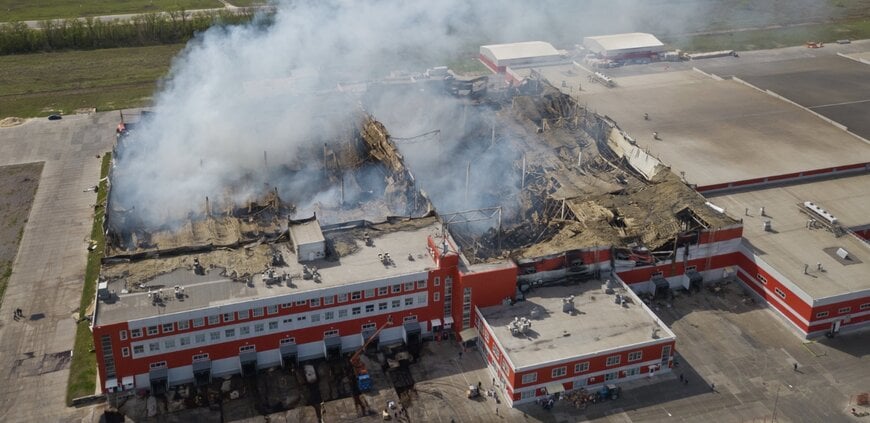
US fire departments respond to roughly 1,544 warehouse structure fires annually. While storage zones account for only 37% of these fire origins, they generate 69% of all direct property damage. This disproportionate loss reveals a clear engineering reality: fire risk profile is dictated by early-stage material handling design. Specifically, automated storage and retrieval systems (ASRS) govern both spatial fire load distribution and the physical reach available to fixed suppression infrastructure and responding crews.
A warehouse fire is fundamentally a business continuity disaster. Beyond capital asset loss, catastrophic disruption to order fulfillment turns recovery downtime into an operations lead's primary metric of failure. The ultimate fire risk of an installation is determined largely by two architectural variables: the spatial density of combustible inventory and the propulsion power delivery model across the machine fleet. TGW’s Stingray shuttle architecture addresses both variables at an engineering level.
Thermal Dynamics and Fire Load Distribution in Storage Topologies
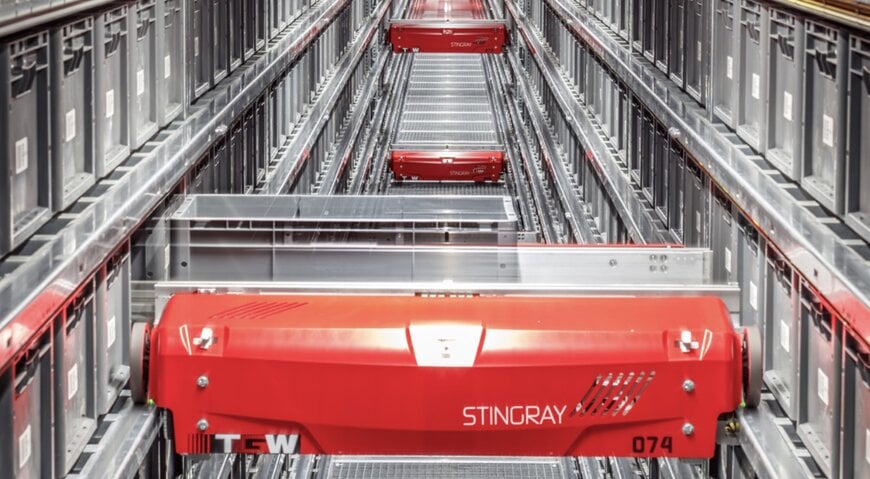
The fundamental architecture of an ASRS dictates fire load concentration and early-stage flame propagation rates. High-density cube architectures consolidate thousands of combustible containers into a single monolithic block, effectively shielding the seat of a deep-seated fire behind continuous product mass. In contrast, TGW’s Stingray shuttle technology distributes payloads across discrete rack levels and dedicated aisles, allocating individual shuttles to defined operational zones.
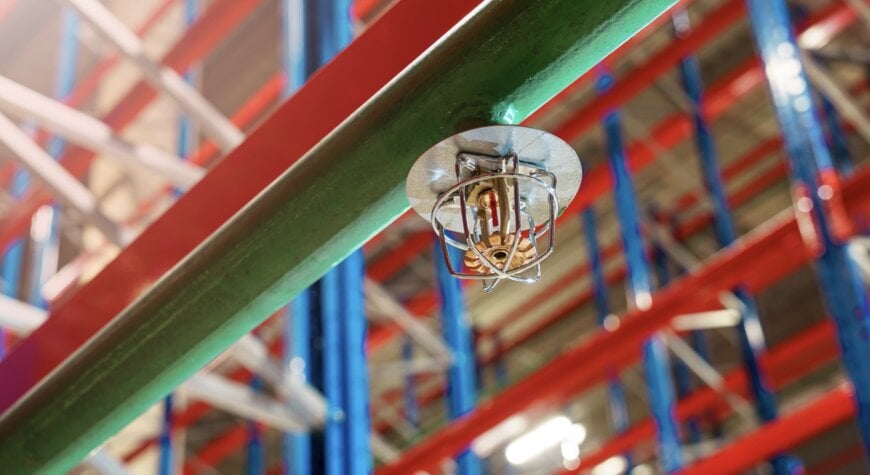
Decentralizing inventory across defined aisle networks eliminates mass fuel consolidation, constraining vertical and horizontal thermal propagation across the storage envelope. Crucially, this opens line-of-sight and penetration envelopes for fixed fire suppression systems. Structural access aisles between shuttle levels deliver functional clearances for targeted sprinkler discharge and manual intervention, while integrated smoke extraction draws off convective heat and toxic combustion products before thermal stratification impairs visibility and sensor triggers.
Electrification Paradigms: Busbar Power versus Mobile Lithium-Ion Arrays
Consumer goods distribution centers operating continuous, high-volume automation fleets face a compounding electrification hazard. Automated Guided Vehicles (AGVs) and Autonomous Mobile Robots (AMRs) rely on decentralized, high-capacity onboard lithium-ion battery packs and localized high-amperage charging banks. While commodity classification and rack heights dominate fire safety reviews, deploying fleets of mobile, battery-operated units introduces a massive, distributed electrochemical fire load often justified solely for system throughput.
Lithium-ion cell failures follow violent, non-standard combustion mechanics. Thermal runaway releases flammable off-gases, generates toxic vapor clouds, and carries a high probability of delayed secondary re-ignition days or weeks post-suppression. Mobile battery platforms introduce dynamic ignition potential: an automated unit experiencing internal cell runaway while navigating can transport active ignition across operational boundaries, transferring fire directly into adjacent racking or staging zones before thermal failure arrests drive mechanics. While static structural fires present fixed containment boundaries, mobile power sources act as vector ignitions traversing the facility floor.
The regulatory framework increasingly reflects these hazards. NFPA highlights the systemic vulnerability of legacy facilities, where legacy buildings engineered for traditional pallet racks now house dense fleets of automated battery systems under sprinkler systems that were never sized for multi-point lithium-ion thermal runaway. NFPA 855 enforces rigorous hazard mitigation analyses across stationary storage systems to isolate runaway and toxic off-gassing. Meanwhile, NFPA 13 specifically excludes lithium-ion battery fire dynamics from its conventional sprinkler-design scopes, leaving battery-intensive facilities operating outside classical density/area suppression curves.
The busbar distribution model eliminates this operational variable. TGW’s Stingray shuttle systems leverage an integrated, continuous busbar conductor rail embedded directly into the physical racking steel. By eliminating heavy onboard lithium-ion cells and sprawling floor-level charging hubs, the system strips out decentralized electrochemical fire loads and preserves rigid mechanical path control. Furthermore, the busbar architecture functions reliably down to -22°F, delivering uniform material handling within chilled and deep-freeze environments without compounding the suppression vulnerabilities typical of low-temperature battery chemistry.
Segmented Architectures and Operational Containment
System availability and fire compartmentalization operate under identical engineering principles: physical and functional segmentation. The Stingray system relies on redundant, segmented operating zones. If a thermal anomaly, electrical trip, or mechanical failure occurs within a specific sector, localized containment protocols isolate that single sub-system while adjacent zones maintain throughput.
Because automated facilities run lights-out shifts—with off-peak hours between midnight and 6 a.m. generating 40% of total direct property damage from only 18% of reported incidents—fail-safe isolation and early detection are crucial. An effective ASRS fire mitigation strategy acts as an integrated sub-tier alongside building design, NFPA-aligned sprinkler hydraulics, early optical or aspirating detection, physical compartmentation, and coordinated incident response protocols.
By incorporating busbar electrification, open-access distributed inventory racking, and segmented control paths as first principles, TGW designs ASRS platforms that directly engineer out core fire risks while preserving facility continuity.
Edited by Romila DSilva, Induportals Editor, with AI assistance.
www.tgw-group.com
