
www.intralogisticsmag.com
15
'26
Written on Modified on
GreyOrange launches AI simulator for warehouse automation planning
GreyMatter Foundry enables high-accuracy simulation of performance, costs, and labor across complex warehouse environments before system deployment.
www.greyorange.com
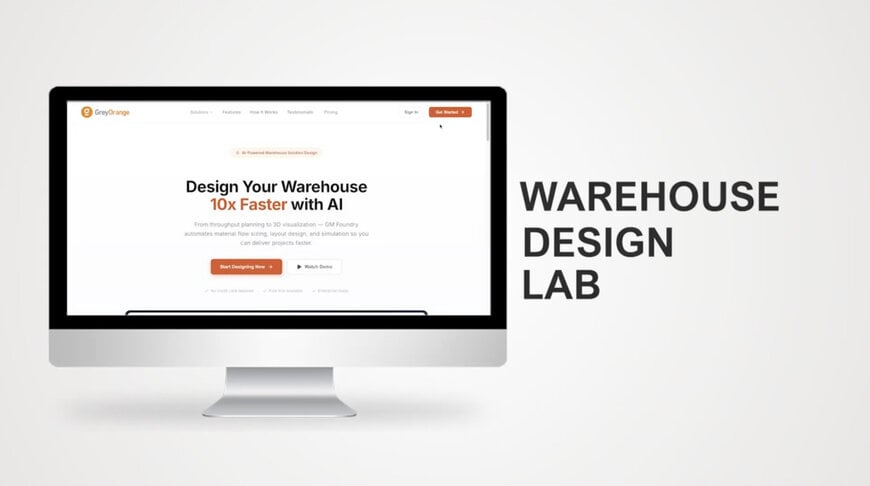
Warehouse automation, logistics engineering, and supply chain optimization increasingly depend on accurate planning tools capable of predicting system performance before implementation. GreyOrange has introduced GreyMatter Foundry, an AI-based simulation platform designed to model warehouse operations, evaluate automation strategies, and estimate costs in a unified digital environment. The solution was presented at MODEX 2026 (APRIL 13-16, Booth #C13190), in Atlanta.
GreyMatter Foundry integrates warehouse flow design, layout planning, and technology sizing into a single simulation framework. This enables operators, system integrators, and fulfillment teams to assess different automation scenarios and predict operational outcomes without committing physical resources.
Bridging simulation and real-world warehouse operations
A key objective of the platform is to reduce the gap between system design and actual warehouse performance. Traditional planning tools often model isolated processes or assume homogeneous systems, limiting their accuracy in environments where multiple automation technologies and human workflows coexist.
GreyMatter Foundry addresses this by supporting heterogeneous simulations, allowing users to model fleets of robots from different vendors alongside manual processes. This is particularly relevant in modern warehouses, where mixed automation environments are common.
The platform leverages operational data from GreyOrange’s existing orchestration system, which coordinates large fleets of robotic agents across deployed sites. By incorporating real-world performance data into simulations, the system can generate predictive models with a reported accuracy of 95% or higher, even in complex, multi-agent environments.
AI-assisted design and scenario modeling
The inclusion of an AI-driven design assistant allows users to configure simulations using conversational inputs or predefined templates. This simplifies the process of defining throughput targets, resource allocation, and workflow configurations.
From an engineering perspective, this approach reduces the time required to build and test simulation models. Scenarios that previously required weeks of analysis can be evaluated within hours, enabling faster iteration during the design phase.
The platform also supports parallel simulation runs, allowing users to explore multiple configurations simultaneously. This is useful for identifying optimal layouts, balancing labor and automation, and evaluating trade-offs between capital investment and operational efficiency.
Planning for scalability and long-term operations
GreyMatter Foundry includes predefined scenarios for long-term planning, enabling users to simulate warehouse performance over five- and ten-year horizons. These models account for changes in demand, inventory profiles, and labor availability, supporting more informed investment decisions.
In practical applications, the system can simulate peak demand conditions, such as seasonal surges, and evaluate how different combinations of automation and staffing affect throughput. It can also predict storage requirements and assess the impact of introducing new product lines or SKUs.
The platform provides 3D visualizations and walkthroughs of warehouse layouts, helping stakeholders understand system behavior and validate design choices before implementation.
Supporting data-driven warehouse automation decisions
The introduction of GreyMatter Foundry reflects a broader shift toward data-driven decision-making in warehouse automation. As systems become more complex, the ability to accurately predict performance, costs, and operational risks becomes critical.
While simulation tools are already used in logistics planning, differentiation typically lies in the level of data integration, the ability to model heterogeneous systems, and the accuracy of predictive outputs. By combining real-world operational data with AI-driven modeling, GreyOrange positions the platform as a tool for reducing uncertainty in automation investments.
Edited by Natania Lyngdoh, Induportals Editor — Adapted by AI.
www.greyorange.com
