
www.intralogisticsmag.com
08
'26
Written on Modified on
Turnkey Automated Warehouse System Optimizes Logistics Flow
Unilever implemented a turnkey Mecalux automated warehouse system in Poland to support production expansion, shortening loading times and halving its forklift fleet.
www.mecalux.com
Application Area: Automated Warehouse Systems (AS/RS), In-House Logistics Integration, Automated Material Handling
Industry Sector: Fast-Moving Consumer Goods (FMCG), Cosmetics and Personal Care
Fast-moving consumer goods (FMCG) manufacturing facilities require high-efficiency logistics to manage diverse stock-keeping units (SKUs) and continuous high-volume output. At its Bydgoszcz plant in Poland—a key site for beauty and personal care items—multinational consumer goods manufacturer Unilever faced operational pressure from ongoing business growth. The production complex required a structured logistics system capable of supporting increased manufacturing volumes while optimizing the movement of both production components and finished products across the facility.
Operationally, the plant needed to secure complete, end-to-end traceability for cosmetics and personal care brands such as Dove, Rexona, TRESemmé, and Vaseline. Managing high operational volumes across a diverse product catalog via traditional manual handling introduced risks of logistical errors and extended vehicle loading delays. To streamline internal logistics resource management, eliminate handling errors, and lower localized operational costs, Unilever deployed an integrated automated warehouse systems network. Mecalux was selected to deliver the project through a turnkey model, assuming full engineering responsibility spanning from initial design and software integration through to final installation commissioning.
Integrating High-Rise Automation with Production Lines and Dispatch Fields
The automated logistics infrastructure transforms internal plant transport and inventory monitoring into a continuous, software-governed digital thread:
- High-Rise Rack-Supported Architecture: The facility features a rack-supported engineering design where the 33-meter-high storage racking serves as the building’s primary structural framework, directly supporting the exterior roof and side cladding. This dense configuration accommodates more than 9,000 pallets arranged across four storage aisles using double-deep racks.
- Automated Product Storage and Retrieval: Material movement within the storage aisles is executed by four automated stacker cranes equipped with telescopic forks. The machines manipulate loads across joint entry-exit movements, achieving up to 130 combined cycles per hour to guarantee a continuous flow of pallets.
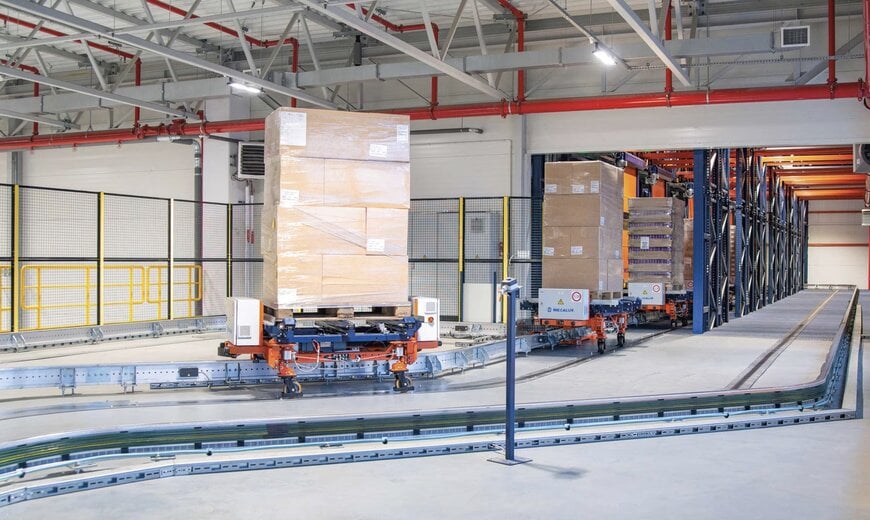
- Enclosed Elevated Transport Bridge: To connect the warehouse seamlessly with distant manufacturing lines and dispatch bays, an enclosed bridge was constructed at a height of 7.5 meters above ground level. Automatic pallet elevators transport products vertically to the bridge elevation, overcoming structural height differences between separate facility sectors.
- Floor-Mounted Electric Monorail System: Inside the elevated bridge, a floor-mounted electric monorail system handles horizontal transport. Operating with 15 autonomous electric trolleys, the monorail automatically shifts pallets between production, storage, and shipping zones. This automated loop has reduced loading times and allowed the plant to halve its active forklift fleet.
- Inventory Control Natively Synced with ERP: Storage allocations for all 9,000 pallet slots are governed by Easy WMS warehouse management software, which assigns physical locations based on SKU classifications and real-time demand variations. The software tracks batch data and provides quality control from manufacturing through international dispatch. By maintaining a direct interface with the plant's core Enterprise Resource Planning (ERP) platform, the system synchronizes industrial planning with material distribution.
Additional Context
The section below examines the technical specifications and operational performance benchmarks not included in the original case study.
Technical Benchmarking of Automated Logistics Systems
Modern industrial facilities utilize automated stacker cranes and floor-mounted electric monorail systems (EMS) to replace traditional manual forklift fleets and conventional mechanical chain or roller conveyors. Automated stacker cranes operating in double-deep configurations maximize spatial efficiency by stacking loads up to 45 meters high, significantly outperforming standard manual reach trucks that face strict lifting limits and require wider access aisles.
In terms of horizontal material transport, traditional roller or chain conveyors typically move at fixed speeds that do not exceed 20 meters per minute and require permanent floor space that obstructs pedestrian and vehicle paths. In contrast, an electrified monorail system utilizes individual, self-powered trolleys that communicate independently to navigate configurable paths. These systems achieve unloaded travel velocities of up to 120 meters per minute and loaded velocities of up to 100 meters per minute for pallets weighing up to 1,500 kilograms. This represents a substantial increase in throughput capacity over long distances while keeping the facility floor unobstructed.
Comparative Analysis of Warehouse Management Architectures
Transitioning from standard manual logging and separate storage operations to an integrated, software-managed automated warehouse alters key operational performance benchmarks:
- Data Synchronization and Stock Tracking: Under traditional documentation workflows, inventory tracking is fragmented; inventory status, material receipts, and shipping schedules are updated manually or via batch data uploads, increasing the risk of stock discrepancies and delayed logistics. Conversely, an integrated WMS platform provides unified data synchronization, utilizing a direct ERP interface to track material flows, update SKU locations, and log batch variations in real time as pallets move through automated checkpoints.
- Operational Accuracy and Error Management: Legacy manual operations exhibit reduced error control because relying on human operators for product placement, picking, and fleet routing introduces frequent fulfillment mistakes, mixed product batches, and misplaced inventory. An automated configuration delivers continuous asset optimization, employing precise telescopic forks, automated stacker crane paths, and systematic software validation to eliminate manual handling errors and secure absolute product traceability.
- Energy and Resource Efficiency: Traditional expansive warehouses experience high operating overhead due to continuous lighting, human-tended forklift battery charging cycles, and spatial inefficiencies caused by low stacking limits. A centralized, high-rise automated system provides optimized resource efficiency; the dense rack-supported architecture minimizes the physical facility footprint, while the automated monorails and stacker cranes adjust active equipment usage dynamically to match the immediate manufacturing load, lowering parasitic power consumption.
Edited by Romila DSilva, Induportals Editor, with AI assistance.
