
www.intralogisticsmag.com
29
'26
Written on Modified on
Visual SLAM Autonomous Mobile Forklifts for Intralogistics Automation
ABB Robotics has expanded its autonomous mobile robot ecosystem to streamline material handling across automotive manufacturing and warehouse operations.
global.abb
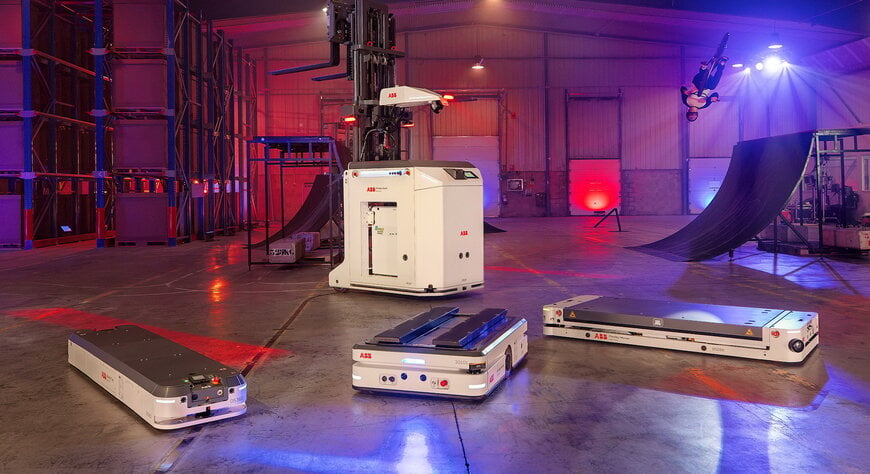
An expansion of autonomous mobile robot portfolios now provides an integrated ecosystem capable of automating diverse material-handling processes using vision-based navigation. The system combines autonomous forklifts, tugs, and movers on a single software platform to support intralogistics across automotive manufacturing, warehousing, and industrial facilities.
Autonomous Forklift Capabilities and Performance Parameters
Managing higher throughput requirements within modern intralogistics demands versatile hardware capable of handling diverse load configurations. The autonomous mobile forklift handles payloads up to 2,000 kg and achieves lifting heights up to 8.5 meters. It processes multiple unit load types, including open and closed pallets, containers, and racks. Technical applications span warehouse storage and retrieval, assembly line supply, end-of-line handling, body and press shops, as well as buffer zone management. Operating at loaded speeds up to 1.7 m/s, the system complies with international ISO and ANSI safety standards.
Infrastructure-Free Navigation via Visual SLAM Technology
Unlike conventional mobile robots that rely on pre-installed magnetic tracks, reflectors, or physical markers, the platform utilizes artificial intelligence combined with Visual Simultaneous Localization and Mapping (Visual SLAM). The onboard vision system maps dynamic environments continuously and makes real-time navigation decisions. Positional accuracy reaches ±10 mm, enabling precise placement in high-density storage configurations.
Commenting on the industry shift toward automated mobility, Marc Segura, President of ABB Robotics, noted that intralogistics operations must process greater volumes within restricted timeframes and under labor availability constraints. Combining advanced vision, mobility, and intelligence into autonomous forklift platforms completes a scalable robotics portfolio designed for dynamic material movement.
Software Integration and Fleet Interoperability
Interoperability across mixed fleets is facilitated through compatibility with the VDA5050 communication interface standard. The central AMR Studio software suite uses a no-code, drag-and-drop interface to configure workflows, coordinate fleet traffic, and provide real-time visualization. Integrating forklifts, tugs, and movers within a unified software architecture reduces commissioning times by up to 20 percent and allows rapid adaptation when production floor layouts change.
Additional Context
This section details technical specifications and competitive benchmarking not included in the original product announcement.
Autonomous mobile forklifts using Visual SLAM offer distinct operational parameters compared to traditional reflector-guided Automated Guided Vehicles (AGVs) and standard LiDAR-based Autonomous Mobile Robots (AMRs). Standard reflector-based AGVs require extensive installation of physical landmarks, adding deployment downtime and infrastructure cost. In contrast, 3D Visual SLAM captures volumetric environmental data, enabling operation in dynamic environments where overhead structures or storage layouts shift frequently. The ±10 mm positioning accuracy matches top-tier LiDAR AMRs, while speed capabilities up to 1.7 m/s under full load place the unit in the upper performance tier for heavy-payload (2,000 kg) high-reach (8.5 m) autonomous forklifts. Adherence to the VDA5050 protocol ensures open interoperability across multi-vendor fleet management software.
Edited by Evgeny Churilov, Induportals Media - Adapted by AI.
www.abb.com
