
www.intralogisticsmag.com
16
'26
Written on Modified on
Electric Vacuum Generation for Mobile Industrial Robotics
Schmalz developed the GSP electric vacuum pump to eliminate compressed air dependencies and improve battery endurance across automated intralogistics workflows.
www.schmalz.com
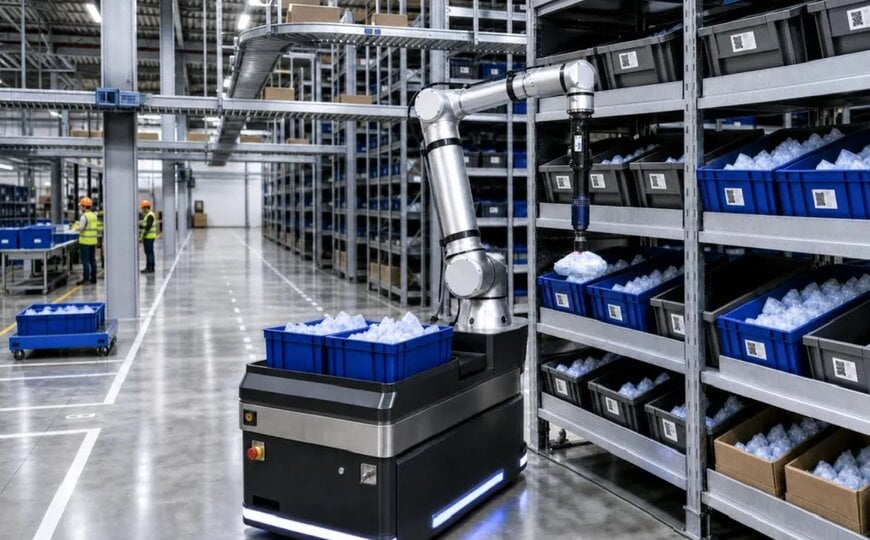
In dynamic material handling, automated guided vehicles and autonomous mobile robots face significant energy constraints when deploying traditional pneumatic ejectors or heavy mechanical pumps. The GSP 24-volt electric vacuum pump from J. Schmalz GmbH resolves this efficiency bottleneck across automotive manufacturing, packaging, and glass handling operations by providing decentralized, high-capacity vacuum handling without compressed air infrastructure.
Decentralized Vacuum Generation for Intralogistics Automation
Automating parcel picking, kitting, and machine loading on mobile robotic platforms requires rapid, gentle gripping without exhausting onboard energy reserves. Historically, production plants relied on pneumatic ejectors to achieve high dynamics and compact tool mounting. However, pneumatic systems require multi-stage energy conversion from electricity to compressed air, followed by compressed-air-driven vacuum creation through Venturi nozzles. This conversion path introduces significant thermodynamic losses, demands centralized compressor piping, and drains onboard batteries when mobile compressors are mounted on automated guided vehicles.
Conversely, legacy electric vacuum pumps such as rotary vane or claw units eliminate compressed air requirements, yet their physical bulk and mechanical inertia make them poorly suited for rapid start-stop cycles. Previous compact electric solutions, including the ECBPi and GCPi series from Schmalz, provided lightweight decentralized alternatives but were mechanically restricted to maximum suction capacities of 50 liters per minute. This airflow limit restricted their deployment on porous corrugated packaging or during high-velocity intralogistics cycles where leakage occurs.
Adaptive Speed Regulation and Energy Reduction
The GSP electric vacuum pump features a direct 24-volt electrical architecture delivering variable suction rates between 50 and 150 liters per minute. Unlike constant-speed vacuum generators that consume continuous baseline power regardless of demand, the integrated closed-loop controller modulates motor speed based on real-time vacuum pressure.
When handling non-porous workpieces such as glass panes or smooth metal sheets, the control system reduces motor speed to zero once the target holding pressure is established, dropping operational power consumption to near zero. Power ramps back up only when handling porous materials or when ambient leakage is detected. Through this closed-loop regulation, the unit reduces total energy consumption by up to 90 percent compared to conventional electric vacuum generators, extending the operational shift duration of battery-powered mobile robots.
System Integration and Fast Cycle Times
Dynamic workpiece handling relies on the coordinated interaction between the vacuum pump and the LQE compact valve. Operating as a plug-and-play assembly, the two components exchange operational parameters autonomously without manual software commissioning.
During transit or positioning dwell phases between picking sequences, the pump pre-charges the vacuum reservoir. Upon contact with the target object, the stored negative pressure releases an instantaneous inflow pulse through the LQE valve, accelerating workpiece evacuation. For part deposition, the valve switches to atmospheric ventilation instead of utilizing compressed-air blow-off jets, reducing release-phase energy use by up to 99 percent while maintaining high cycle frequencies in high-throughput fulfillment centers.
Connectivity, Diagnostics, and Operational Safety
To accommodate modern industrial automation ecosystems, the GSP automatically identifies its connection environment. If connected to an IO-Link master, the device automatically activates digital communication to stream real-time vacuum levels, system health metrics, and preventative diagnostics to the plant programmable logic controller. Alternatively, standard digital input and output lines can be used for discrete switching.
Field diagnostics and setup parameters are accessible locally via an integrated color screen or wirelessly through a Near Field Communication (NFC) smartphone interface. The embedded control software measures pressure curve gradients during pickup to determine workpiece surface porosity — distinguishing between porous cardboard, engineered plastics, and sheet metals — and sets operational flow parameters accordingly. In the event of main grid failure or supply disconnection, an optional uninterruptible power supply (UPS) circuit maintains negative holding pressure on non-porous loads for up to 20 hours.
Additional Context
This section details technical specifications and competitive benchmarking not included in the original product announcement.
Industrial vacuum gripping systems on mobile manipulators operate under stringent payload-to-power constraints dictated by international automation standards such as ISO 3691-4 for driverless industrial trucks and ISO 10218 for industrial robotics. In battery-driven end-of-arm tooling, common electric benchmarks include compact decentralized units like the Piab piCOBOT electric series and OnRobot VGC10/VG10 vacuum grippers.
While compact decentralized end-of-arm tools typically deliver suction volumes between 10 and 40 liters per minute to minimize end-effector weight, they struggle to sustain safe holding forces on high-porosity packaging materials, such as recycled kraft corrugated board, without secondary auxiliary pumps. Centralized multi-ejector pneumatic systems historically delivered airflow rates above 100 liters per minute to compensate for packaging porosity, but they imposed total pneumatic system efficiencies often falling below 10 to 15 percent when factoring in central compressor generation, pipe friction, and Venturi losses.
Standardization initiatives across European manufacturing, driven by energy efficiency standards such as ISO 50001, increasingly push industrial facilities to eliminate compressed air consumption outside stationary machinery cells. The transition to native 24-volt DC decentralized vacuum systems operating directly on direct current bus architectures eliminates the 6 to 8 bar pneumatic infrastructure entirely, standardizing electrical interfaces across mobile platforms while reducing total lifecycle energy costs in logistics environments.
Edited by Evgeny Churilov, Induportals Media - Adapted by AI.
www.schmalz.co.jp
