
www.intralogisticsmag.com
26
'25
Written on Modified on
Mecalux Explores How AI Transforms The Future Of Logistics
AI-driven warehouse management, automated decision-making, and generative tools are redefining supply chain efficiency, demand forecasting, and robotic performance for businesses.
www.mecalux.com
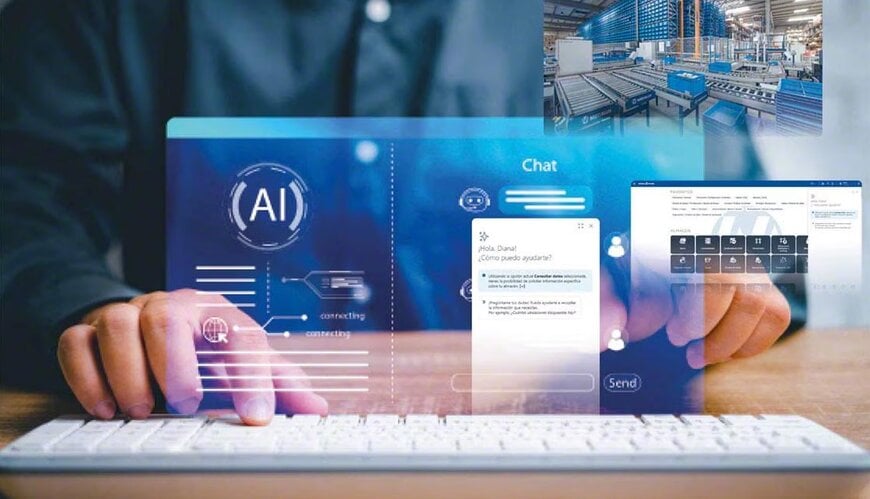
Artificial intelligence (AI) is no longer a speculative concept in logistics. It has become integral to modern supply chain operations and a key differentiator for companies seeking greater performance, resilience, and cost efficiency. By embedding AI across logistics functions, businesses can outperform competitors that rely on traditional planning and reactive decision-making. This article examines how AI technologies transform logistics workflows from warehouse operations to strategic planning and transport optimization, and why these changes matter in a competitive marketplace.
Transformation of Core Logistics Operations
In the current logistics landscape, AI fundamentally alters how organizations plan, execute, and monitor supply chain processes. Leading firms harness AI to forecast demand with greater precision, manage inventory dynamically, and maintain continuous traceability of assets and shipments. AI systems process real-time and historical data to predict delivery times, select cost-effective transport routes and propose alternative solutions when disruptions occur. This real-time responsiveness, which is difficult to achieve with conventional systems, enhances reliability and operational efficiency.
AI-Driven Warehouse Management as a Competitive Edge
Warehouse management remains one of the most impactful areas where AI drives differentiation. Advanced warehouse management systems (WMS) infused with machine learning and generative AI convert raw operational data into actionable insights that improve throughput and reduce inefficiencies. These systems support dynamic routing of goods, more accurate demand prediction, and interactive decision support through natural language interfaces. Such capabilities shift warehouses from reactive facilities into proactive command centers that continuously optimize their own performance.
Beyond data interpretation, AI supports scenario simulation and performance analytics. This allows logistics managers to anticipate potential issues and adjust strategies before problems escalate, a capability traditional tools struggle to match. The integration of AI with robotics, including autonomous mobile robots that navigate and fulfil tasks within facilities, further raises productivity and reduces reliance on manual labor.
Enhancing Order Allocation and Distribution
AI is also redefining how orders are allocated, routes are determined, and deliveries are executed. Intelligent systems monitor inventory levels in real time, triggering replenishment and shipment preparation automatically. These systems apply advanced learning models to recognize patterns and adapt to variations in demand, traffic conditions or supply chain disruptions, leading to faster and more reliable fulfilment.
In transport operations, AI enables dynamic route optimization that continuously adjusts to real-time conditions and historical performance, reducing both transit times and fuel costs. Integration with distributed order management platforms helps logistics networks select the most efficient fulfilment points and coordinate deliveries across multiple facilities, further strengthening competitive positioning through reduced delivery times and improved customer satisfaction.
Strategic Decision Automation and Adaptive Planning
A significant advantage of modern AI implementations in logistics is the automation of strategic decisions traditionally made through manual analysis or static tools. AI systems ingest large volumes of diverse data, including traffic, demand fluctuations and inventory levels, to optimize distribution network design and capacity planning continuously. Rather than relying on periodic reviews, organizations can maintain an adaptive supply chain that responds instantly to market shifts and disruptions.
This capacity for automated strategic planning positions companies that utilize AI above competitors that depend on slower, less responsive methods. It enables logistics leaders to reallocate resources, adjust service commitments and redesign distribution strategies with minimal delay, preserving service levels under changing conditions.
Machine Learning and Automation Beyond Traditional Limits
Beyond improving individual tasks, AI extends to predictive maintenance, machine vision and traffic control for automated systems. By identifying equipment issues before failure, AI helps logistics operators reduce downtime and maintenance costs. Computer vision enhances the autonomy and accuracy of robots used in material handling. In automated fleets, real-time optimization algorithms coordinate movement to prevent internal congestion or collisions, improving throughput and safety.
Ongoing research collaborations between industry and academic institutions are advancing AI models capable of learning and adapting autonomously to complex environments. This research supports the development of autonomous logistics systems that can self-optimize order distribution and equipment movement over time, creating capabilities beyond traditional automation.
Looking Forward: AI as a Structural Imperative for Logistics Competitiveness
AI’s role in logistics is expanding from tactical support to structural transformation. Real-time visibility, predictive analytics and automated decision support are evolving into baseline expectations for performance rather than optional enhancements. Companies that adopt integrated AI solutions position themselves to reduce costs, accelerate operations, improve customer service and adapt more swiftly to disruptions than competitors that delay or limit their AI investments.
In the coming years, AI is expected to further elevate global logistics capabilities by enabling smarter resource allocation, reducing operational variability and creating supply chain architectures that anticipate market needs rather than merely react to them. Organizations that align logistics strategy with AI-enabled tools will therefore gain a sustainable competitive advantage in markets defined by speed, scalability and resilience.
www.mecalux.com
