
www.intralogisticsmag.com
28
'26
Written on Modified on
Autonomous mobile robot adds adaptive mast configurations
OMRON expands the OL-450S autonomous mobile robot platform with new mast options for cart transport and intralogistics automation.
industrial.omron.eu
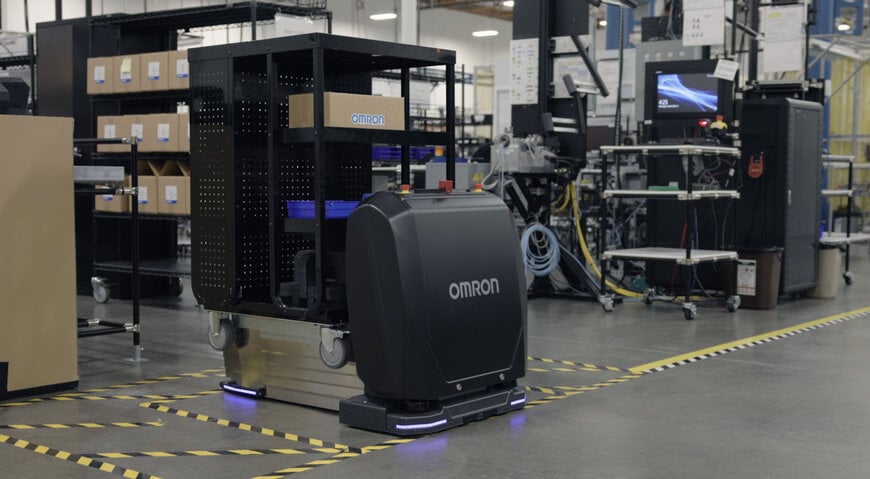
OMRON Robotics and Safety Technologies has introduced expanded mast configuration options for its OL-450S autonomous mobile robot (AMR), adding new deployment variants intended to improve navigation and localization across different manufacturing and intralogistics environments.
The updated OL-450S platform is available in three configurations: a standard no-mast version, a 1.2 m mid-mast option, and a 1.6 m full-mast configuration. These variants are designed to help manufacturers and system integrators adapt autonomous transport systems to facility-specific ceiling heights, traffic density, workflow layouts and operational constraints.
Adaptive navigation for industrial material handling
The no-mast configuration maintains the robot’s lowest operating profile for deployment in compact production areas with restricted vertical clearance. According to OMRON, this configuration supports safe cart transport through narrow aisles, low overhead sections and spaces surrounding fixed production equipment.
The mid-mast version introduces elevated scanning capabilities for facilities with higher traffic density and more dynamic movement patterns. By positioning the scanner above floor-level obstacles and activity, the robot can improve localization performance in environments shared by operators, carts and mobile equipment while maintaining compatibility with elevators and low-clearance infrastructure.
For larger production facilities and complex intralogistics operations, the full-mast configuration provides the highest scanner position to maximize environmental visibility and navigation stability. OMRON states that the higher reference point enables the robot to identify stable environmental features above ground-level activity, improving navigation consistency in visually complex industrial spaces.
The three configurations are intended to allow manufacturers to deploy the same mobile robot platform across multiple facility types while adapting navigation performance to operational requirements.
Cart transport automation with integrated lifting system
The OL-450S is designed as a turnkey autonomous cart transport system for manufacturing and warehouse operations. The robot combines a compact chassis with an integrated lifting plate and supports payload capacities up to 450 kg.
The lifting mechanism provides a vertical range from 108 mm to 308 mm, enabling the robot to position itself underneath transport carts, lift them securely and automate existing material handling workflows without major modifications to infrastructure.
Across all configurations, the OL-450S uses omni-directional mobility to move laterally, rotate in place and maneuver through changing factory layouts. The system also incorporates natural feature navigation, onboard sensing systems and wireless charging technology to reduce manual intervention during operation.
OMRON additionally stated that the lifting plate can be modified within defined engineering constraints through raising, widening or extending the platform to support application-specific cart designs and varying payload dimensions.
Centralized AMR fleet management with FLOW Core
The OL-450S platform operates through FLOW Core, OMRON’s centralized fleet management software for autonomous mobile robots. The platform provides centralized coordination of robot traffic, task scheduling and fleet operations from a single control interface.
FLOW Core supports mixed fleets of up to 100 mobile robots with varying payload capacities. Real-time monitoring of robot activity and workflow execution allows manufacturers to coordinate transport operations across production and warehouse environments.
According to Justin King, Vice President of Product Management, Marketing and Business Development at OMRON Robotics, the expanded OL-450S range is intended to provide manufacturers with automation systems that can operate within existing production constraints instead of requiring facilities to adapt to fixed robotic configurations.
The announcement reflects broader industry demand for flexible autonomous material handling systems capable of operating across diverse industrial layouts while minimizing infrastructure modifications.
Additional Context: Technical specifications and competitive benchmarking not included in the original product announcement
The OL-450S operates within the growing market for autonomous mobile robots used in manufacturing logistics, warehouse transport and intralogistics automation. Comparable platforms include MiR250 Hook from Mobile Industrial Robots (MiR), OTTO 600 from OTTO Motors and Fetch Robotics cart transport systems from Zebra Technologies.
Most industrial AMRs in this category use simultaneous localization and mapping (SLAM), LiDAR-based navigation and onboard obstacle detection to support autonomous movement in dynamic industrial environments. Elevated sensor positioning, similar to the mast configurations introduced by OMRON, is increasingly used to improve environmental visibility in facilities with high traffic density or changing layouts.
Payload capacity is a major benchmark within autonomous cart transport systems. With support for loads up to 450 kg, the OL-450S competes in the medium-payload AMR category commonly deployed in automotive manufacturing, electronics production and warehouse logistics.
Omni-directional mobility systems provide an operational advantage in constrained manufacturing environments because they allow lateral movement and zero-radius turning. This capability is particularly relevant for narrow aisles and production cells with limited maneuvering space.
Centralized fleet management platforms such as FLOW Core are becoming increasingly important as manufacturers scale AMR deployments across multiple production zones. Fleet orchestration software typically manages traffic routing, charging schedules, task prioritization and collision avoidance across mixed robot fleets.
Edited by Sucithra Mani, Induportals editor – adapted by AI.
www.omron.com
