
www.intralogisticsmag.com
29
'26
Written on Modified on
VisionNav Robotics Launches Autonomous Precision Stacking Solution
Unveiled at Modex 2026, the VNE40-66 Autonomous Precision Stacking Solution combines robust strength, exacting accuracy and uncompromising safety for large container marketplace environments.
www.visionnav.com
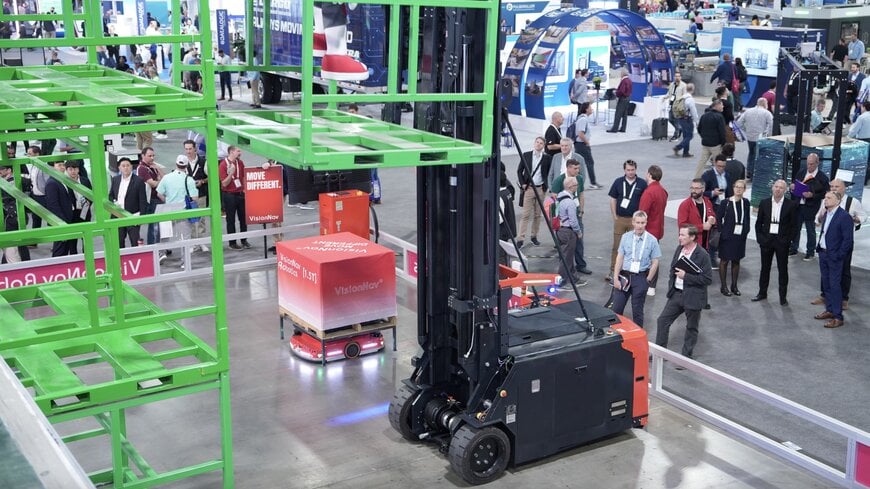
VisionNav Robotics has introduced an autonomous stacking system engineered specifically for large container environments where accuracy, stability and safety are paramount. Introduced at Modex 2026, the company's VNE40-66 Autonomous Precision Stacking Solution can stack 8.8-foot-wide cages weighing up to 6,150 pounds at heights of up to 22 feet – the market's first such solution to achieve such robust capabilities.
To achieve this level of performance with total stability and accuracy, the unit utilizes VisionNav's proprietary sensor fusion technology that provides millimeter-level precision compatible with various post types, ensuring each placement is exact despite differing container sizes or environmental conditions. Reliable and robust, the system carries a rated payload of 6,150 pounds, making it suitable for the exceptionally heavy, wide containers common in automotive and other heavy-duty settings.
Among the VNE40-66's most attractive features is its Smart Retry Functionality, which continuously monitors for misalignments and anomalies in real time; if misaligned containers, incorrect position posts or other adverse issues are identified, the system aborts and retries without requiring operator input. This dramatically reduces downtime, minimizes risk of product damage, and supports fully autonomous operation in high-throughput environments where human intervention would create untenable bottlenecks.
Technology-driven Safety Features
The VNE40-66 Autonomous Precision Stacking Solution's safety capabilities are as sophisticated as its stacking precision. This intelligent, context-aware safety envelope ensures that the system responds appropriately to real operating conditions rather than relying on static safety margins. For example, during straight-line travel, a dynamic brake zone scales to the size of the load being carried, with larger goods generating wider, deeper boundaries. Through corners and curves, zones reconfigure to match the vehicle's turning geometry.
A key differentiator of the VNE40-66 is its dedicated manual forklift fork protection system, which detects approaching forklift forks across three distinct scenarios. Critically, the solution can detect whether other vehicle forks are on the ground or lifted – a capability especially valuable in mixed human-robot environments. Dedicated protection zones are applied during the forklift lifting cycle itself, with distinct profiles for both empty and full load conditions. The module's protection zone geometry adjusts depending on whether the forklift is carrying a load, ensuring the right level of protection across various operational states.
A departure from conventional standalone 2D or LiDAR obstacle protection, the VNE40-66 integrates both into a single comprehensive safety system. A mechanical safety design ensures structural integrity throughout all operational scenarios, with safety lasers providing 360-degree assessment – a comprehensive awareness perimeter regardless of approach direction. Complementing these features, an auxiliary 3D protection system adds a dynamic layer of spatial intelligence based on real-time monitoring of the vehicle's maximum operating length and width.
Additional Context
This section details technical specifications and competitive benchmarking not included in the original news release.
Automated guided forklifts and high-capacity stackers are technically reviewed using performance metrics governed by the American National Standards Institute (ANSI/ITSDF B56.5), focusing on continuous high-lift residual capacities, safety sensor response latencies, and total structural deflection under maximum load limits. Standard autonomous counterbalanced lift trucks from competitors like Balyo (with the Reachy series) or Toyota Material Handling (utilizing the Core IC Automated Forklift framework) generally restrict their high-stacking payloads to standard 48-inch-wide pallets, experiencing severe derating when lifting footprints exceed standard width margins due to forward center-of-gravity displacement.
The VNE40-66 platform alters this benchmark by maintaining its full 6,150-pound lifting capacity across wide 8.8-foot (106-inch) industrial cages at heights reaching 22 feet. This architectural stability is achieved by increasing the chassis wheelbase and integrating heavy-duty double-frame steel mast channels that minimize lateral mast twisting to less than 0.5 degrees under full structural extension. While legacy automated reach trucks utilize standard 2D laser scanners that require flat, vertical reflector targets to preserve navigation locks, the sensor fusion layer on this unit merges data from high-resolution time-of-flight cameras with dual-frequency safety lidar units.
Edited by Romila DSilva, Induportals Editor, with AI assistance.
www.visionnav.com
