
www.intralogisticsmag.com
01
'26
Written on Modified on
Vertical Cable Carrier Systems for Automated Material Handling
Component manufacturer igus has developed a compact vertical cable carrier mechanism for storage and retrieval units reaching vertical distances of 50 meters.
www.igus.eu
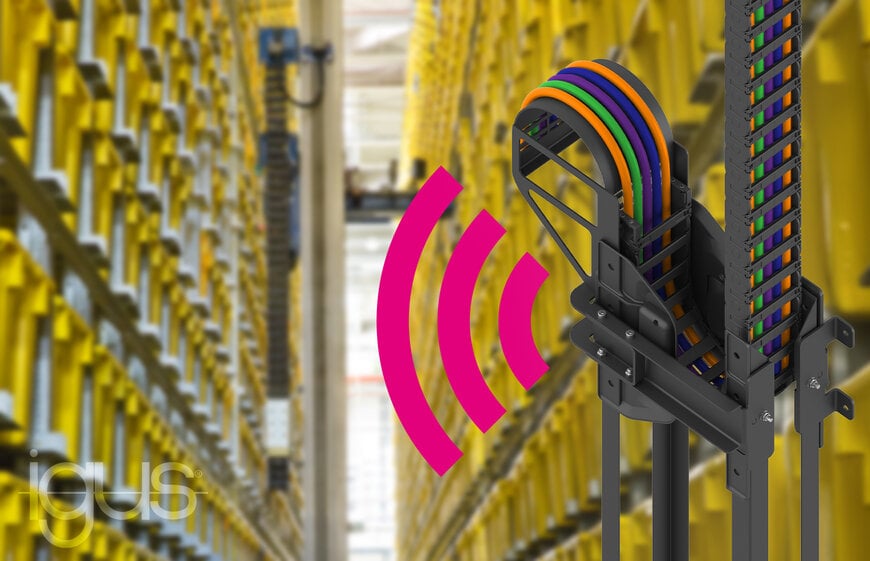
The material handling sector requires specialized architectural configurations to optimize warehouse footprints, directly affecting automated storage and retrieval systems (AS/RS), elevators, and cranes. To address vertical power and data transmission over distances up to 50 meters, igus has engineered the guidelok slimline GLSL.P.S.2, a glass-fiber-reinforced plastic cable management system. This architecture functions as an alternative to rigid conductor rails and metallic guide channels, offering a unified conduit for power, control signals, and data within confined intralogistics environments.
Space Optimization in Vertical Intralogistics
Automated warehouse operations rely on high-density storage configurations, leading to taller racks and narrower aisles. This spatial constraint requires moving components and load-handling equipment to utilize compact energy supply mechanisms along vertical masts. Traditional conductor rail systems present limitations regarding data transmission capabilities and installation complexity. Conversely, conventional steel or aluminum cable chains possess larger physical footprints and mass, making them susceptible to lateral acceleration forces during operation. The engineered plastic and composite structure of the guidelok system mitigates these operational barriers by reducing overall system weight and structural bulk.
Dynamic Performance and Stabilization Mechanisms
Operating dynamics for the guidelok slimline system support travel speeds up to 7 m/s and acceleration rates of up to 10 m/s². The structural design utilizes U-shaped guide rails mounted in opposing pairs at defined intervals along the AS/RS mast. With the fixed point of the Series 2700 chain positioned at the vertical midpoint of the travel path, the carrier follows the motion of the load-handling device. To manage lateral swinging, vibration, and noise, the system incorporates spring-loaded plastic stabilization elements within the guide rails. During vertical transit, the bending radius of the moving chain pushes these elements aside mechanically, allowing unobstructed passage while maintaining chain alignment.
Dimensional Specifications and Component Installation
The dimensional footprint of the guidelok slimline GLSL.P.S.2 relies on a reduced distance between side rails, resulting in an overall system width of under 350 millimeters and a depth of 226 millimeters. The internal width capacity for cables is 100 millimeters, accommodating a minimum bend radius of 75 millimeters. This narrow profile facilitates integration into spatially restricted elevator shafts and crane structures. Furthermore, the glass-fiber composite rails and tribologically optimized plastic guide elements are supplied preassembled. Installation requires anchoring four screws per section directly to the mast, streamlining integration without requiring complex alignments. The system architecture also supports sensor integration for condition monitoring and predictive maintenance protocols.
Additional Context: This section details technical specifications and competitive benchmarking not included in the original product announcement.
Vertical energy supply in material handling is historically dominated by three technologies: busbar systems, festoon configurations, and metallic cable carriers. Busbars provide highly efficient power transmission but face fundamental limitations in carrying pneumatic hoses or shielded Ethernet and fiber-optic data cables required for continuous AS/RS sensor communication. Metallic drag chains accommodate variable media but introduce significant dead weight, requiring larger drive motors to overcome structural inertia. By utilizing glass-fiber-reinforced plastics, vertical chain systems achieve a specific weight reduction of up to 50 percent compared to steel equivalents. This reduction in moving mass directly lowers the energy consumption of the mast's vertical axis drive while meeting the high-cycle fatigue requirements of automated warehousing operations.
Edited by an industrial journalist, Lekshman Ramdas, with AI assistance.
www.igus.com
