
www.intralogisticsmag.com
03
'26
Written on Modified on
3D Smart Camera Automates Crate Completeness Verification
The Contrinex Smart Camera 3D utilizes integrated Time-of-Flight (ToF) technology to provide real-time, automated crate completeness verification for industrial packaging and logistics lines.
www.us.contrinex.com
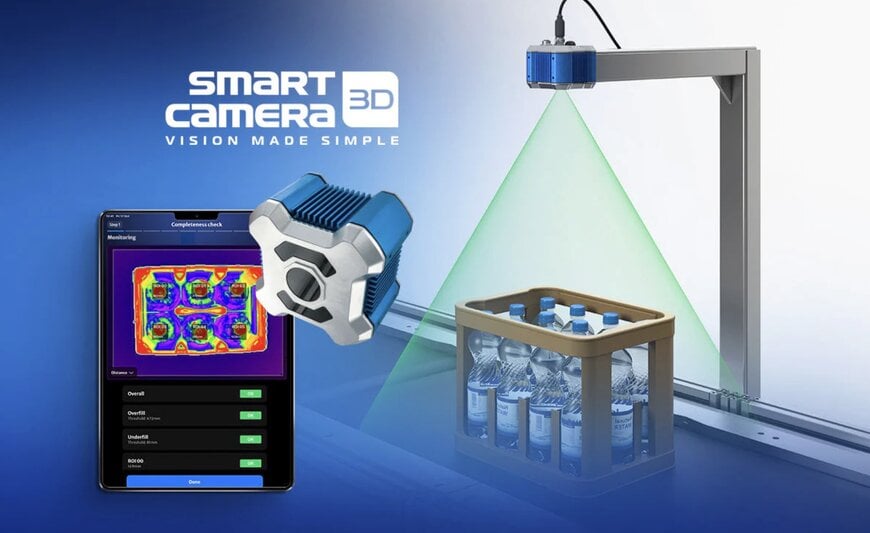
In automated bottle-filling applications, maintaining precise inventory control inside transport crates is essential to prevent operational disruptions. Each defined crate compartment must contain exactly one correctly oriented bottle. Standard production lines regularly experience packaging inconsistencies, such as missing items, misaligned or tilted bottles, and double-stacked bottles that protrude vertically above the crate edge.
When undetected, these variances cause structural conveyor jams, automated palletizing errors, product damage, and incomplete shipping deliveries that lead to expensive returns. Manual inspections and conventional 2D vision systems frequently face limitations in resolving these depth-based defects, particularly when deployed in challenging industrial environments with unstable lighting conditions.
Onboard 3D Imaging and Depth Evaluation
The Smart Camera 3D addresses these limitations by integrating 3D imaging sensors with onboard processing units to execute real-time completeness checks directly on active production lines. The system uses precise depth measurement data to calculate vertical dimensions, enabling the simultaneous detection of two distinct fault conditions:
- Overfill Conditions: The sensor identifies objects protruding beyond the maximum allowable crate height, capturing occurrences like double-stacked bottles before they can interfere with downstream conveyor or palletizing machinery.
- Underfill Conditions: The system detects empty slots within designated crate positions, flagging missing bottles to eliminate incomplete shipments and subsequent customer complaints.
Cross-Platform Configuration and Deployment
System deployment is facilitated through the companion Smart Vision App, which includes a preconfigured completeness check algorithm alongside an intuitive, no-code setup wizard. The application interface allows plant operators to teach specific bottle and crate geometries, establish defined inspection zones, configure localized filling criteria, and view live inspection results. The software is compatible across iOS, Android, and Windows operating systems, enabling plug-and-play production integration without requiring specialized machine vision programming knowledge.
By identifying overfill and underfill status in real time, the standalone 3D system assists packaging operations in mitigating shipping errors, lowering product return costs, preventing machinery downtime, and removing manual quality control steps across varying crate and bottle formats.
Additional Context
This section details technical specifications not included in the original news release.
The Contrinex Smart Camera 3D (such as model CAM-3TIQC-C99S-SF-A) operates on the Continuous Wave (CW) Modulation Time-of-Flight principle. The hardware features an integrated infrared light source consisting of four Vertical-Cavity Surface-Emitting Lasers (VCSEL) emitting at a modulated wavelength of 850 nm, classified under Laser Class 1 safety standards. The receiver incorporates a solid-state sensor array providing a native QVGA resolution of 320 x 240 pixels. By calculating the phase shift between the emitted sinusoidal infrared light signal and the reflected signal returned to each individual pixel, the camera derives absolute spatial coordinates to construct a 3D point cloud with a depth measurement repeatability of up to ±5 mm.
The camera features a physical field of view (FoV) of 37° x 27.9° (46.1° diagonal) and supports adjustable operating ranges tailored via short-range modes (300 to 3750 mm) or long-range modes (300 to 7500 mm) depending on object reflectivity. Onboard processing is executed locally, yielding a maximum image treatment and evaluation frequency of up to 10 to 25 Hz.
Industrial connectivity is established using dual standard M12 connectors: a 5-pin A-coded male plug for 24 VDC power supply and IO-Link (COM3 transmission rate at 230.4 kbit/s), and a 4-pin D-coded female plug supporting 100 Mbps Fast Ethernet. Local parameterization and data extraction utilize a built-in Wi-Fi access point (802.11 b/g/n at 2.4 GHz) running a secure REST API. The physical construction is housed in a rugged rectangular aluminum, polycarbonate (PC), and polyamide (PA) enclosure measuring 92 x 92 x 81 mm, weighing 470 g, and carrying an IP65/IP67 ingress protection rating to withstand harsh industrial ambient temperatures from 0°C to +50°C.
Edited by Romila DSilva, Induportals Editor, with AI assistance.
System deployment is facilitated through the companion Smart Vision App, which includes a preconfigured completeness check algorithm alongside an intuitive, no-code setup wizard. The application interface allows plant operators to teach specific bottle and crate geometries, establish defined inspection zones, configure localized filling criteria, and view live inspection results. The software is compatible across iOS, Android, and Windows operating systems, enabling plug-and-play production integration without requiring specialized machine vision programming knowledge.
By identifying overfill and underfill status in real time, the standalone 3D system assists packaging operations in mitigating shipping errors, lowering product return costs, preventing machinery downtime, and removing manual quality control steps across varying crate and bottle formats.
Additional Context
This section details technical specifications not included in the original news release.
The Contrinex Smart Camera 3D (such as model CAM-3TIQC-C99S-SF-A) operates on the Continuous Wave (CW) Modulation Time-of-Flight principle. The hardware features an integrated infrared light source consisting of four Vertical-Cavity Surface-Emitting Lasers (VCSEL) emitting at a modulated wavelength of 850 nm, classified under Laser Class 1 safety standards. The receiver incorporates a solid-state sensor array providing a native QVGA resolution of 320 x 240 pixels. By calculating the phase shift between the emitted sinusoidal infrared light signal and the reflected signal returned to each individual pixel, the camera derives absolute spatial coordinates to construct a 3D point cloud with a depth measurement repeatability of up to ±5 mm.
The camera features a physical field of view (FoV) of 37° x 27.9° (46.1° diagonal) and supports adjustable operating ranges tailored via short-range modes (300 to 3750 mm) or long-range modes (300 to 7500 mm) depending on object reflectivity. Onboard processing is executed locally, yielding a maximum image treatment and evaluation frequency of up to 10 to 25 Hz.
Industrial connectivity is established using dual standard M12 connectors: a 5-pin A-coded male plug for 24 VDC power supply and IO-Link (COM3 transmission rate at 230.4 kbit/s), and a 4-pin D-coded female plug supporting 100 Mbps Fast Ethernet. Local parameterization and data extraction utilize a built-in Wi-Fi access point (802.11 b/g/n at 2.4 GHz) running a secure REST API. The physical construction is housed in a rugged rectangular aluminum, polycarbonate (PC), and polyamide (PA) enclosure measuring 92 x 92 x 81 mm, weighing 470 g, and carrying an IP65/IP67 ingress protection rating to withstand harsh industrial ambient temperatures from 0°C to +50°C.
Edited by Romila DSilva, Induportals Editor, with AI assistance.
