
www.intralogisticsmag.com
30
'26
Written on Modified on
Integrated Lithium-Ion Architecture in Compact Electric Forklifts
Fenwick-Linde introduces a new range of material handling equipment designed to optimize energy management and operator ergonomics in confined industrial environments.
www.fenwick-linde.fr
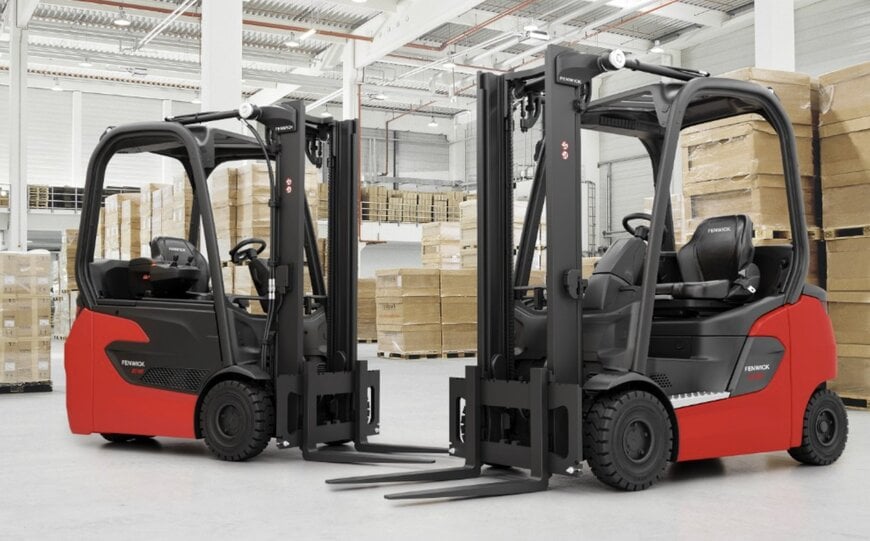
Fenwick-Linde has released the Ei14 to Ei20 series of three- and four-wheel electric forklifts, featuring an integrated 48V lithium-ion battery architecture. Engineered for low to medium-intensity operations and loads ranging from 1.4 to 2.0 tonnes, these models target logistics, warehousing, and cold storage applications where machinery must operate efficiently in temperatures as low as -20 degrees Celsius.
Lithium-Ion Architecture and Industrial Energy Efficiency
The transition from conventional lead-acid battery designs to an integrated lithium-ion setup provides specific operational changes in energy management. Because lithium-ion batteries do not emit gases during the charging cycle, the requirement for dedicated, ventilated charging facilities is eliminated, allowing facility managers to reclaim floor space. Furthermore, the technology supports opportunity charging during standard operational breaks, maintaining continuous machine availability without the need for overnight charging cycles or routine fluid maintenance. An optional on-board charger allows the equipment to interface with standard electrical outlets, adding flexibility to deployment across varying warehouse zones.
Structural Adjustments and Operator Ergonomics
Removing the traditional battery compartment allows for structural modifications to the cab environment. This geometric shift increases the operator's legroom by 35 percent, promoting a seated posture that mitigates physical strain over extended shifts. Additionally, the chassis redesign lowers the access step to 40 centimeters above the ground.
Highlighting the operational rationale for these structural changes, Marion L'Her, Product Manager at Fenwick-Linde, notes, "These advantages are particularly useful in this load class, where operators frequently get on and off their trucks."
Handling Performance and Automated Safety Mechanisms
Propelled by 48V asynchronous motors, the forklifts reach maximum travel speeds of 20 km/h to facilitate rapid goods transfer. To navigate confined spaces, the three-wheel models utilize a single-turret axle, while the four-wheel variants (Ei16 to Ei20P) feature a double-turret axle, maintaining a tight turning radius.
The vehicles integrate multiple sensor-driven assistance systems to govern stability. The Curve Assist module dynamically limits travel speed based on the detected steering angle, while the Load Assist system processes data from pressure sensors and lift-height indicators to mitigate the risk of forward tipping. Facilities with stricter safety protocols can deploy supplementary systems, including Speed Assist for automatic deceleration upon entering indoor zones, and Safety Pilot for continuous load monitoring.
Digital Supply Chain Integration and Telemetry
Built on a comprehensive electronic architecture, the Ei14 to Ei20 models support advanced telemetry for digital supply chain environments. An optional data transmission unit captures operational hours and system fault codes, broadcasting this data securely to fleet management applications. This connectivity allows maintenance teams to execute system updates and activate specific functional software remotely, reducing physical diagnostic downtime.
Additional Context
This section details technical specifications and competitive benchmarking not included in the original news release.
Within the 1.4 to 2.0-tonne electric counterbalance forklift segment, integrated lithium-ion chassis designs are replacing older models that merely swapped lead-acid battery boxes for lithium-ion inserts. Comparable solutions from manufacturers such as Jungheinrich and Toyota Material Handling also utilize this structural integration to lower the vehicle's center of gravity. By embedding the battery directly into the truck’s framework, manufacturers improve weight distribution and static stability, which enhances safety during heavy block stacking without relying exclusively on electronic load assistance software. Furthermore, standardizing on a 48V architecture across this weight class balances the thermal management requirements of the battery with the necessary torque output for steep ramp inclines and rapid acceleration cycles.
Edited by Aishwarya Mambet, Induportals Editor, with AI assistance.
www.fenwick-linde.com
