
www.intralogisticsmag.com
06
'26
Written on Modified on
Low-Level Order Pickers for High-Efficiency Logistics
Fenwick-Linde launches the new-generation N20-N25 series order pickers, featuring an advanced driving position and compact L2 length to optimize warehouse safety and maneuverability.
www.fenwick-linde.fr
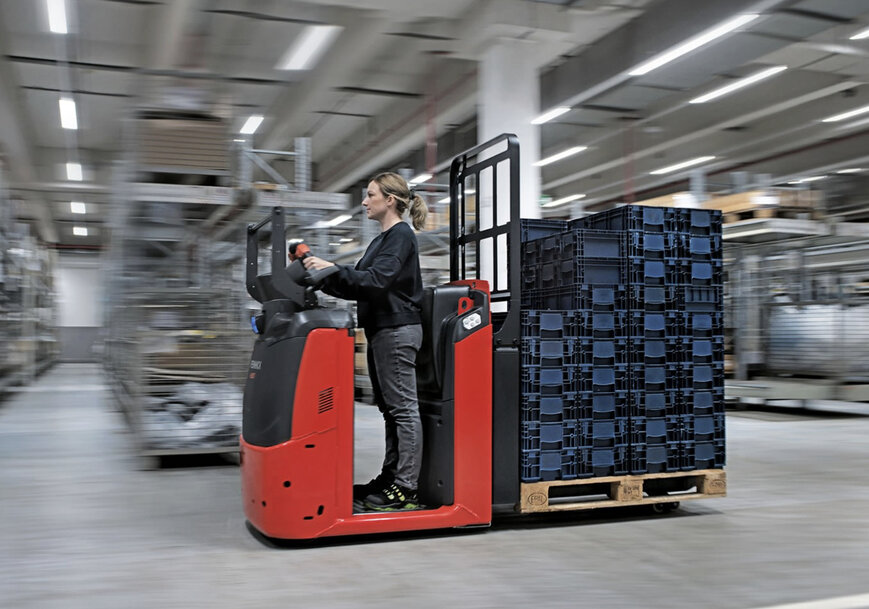
The introduction of the N20-N25 series establishes a new benchmark for ergonomics, safety, and operational efficiency in demanding industrial environments. Designed for rapid picking cycles, these low-level order pickers are tailored for high-throughput sectors such as retail, e-commerce, transport, and automotive logistics.
Advanced Visibility and Integrated Safety Technologies
The primary engineering innovation of this new generation is the forward-positioned operator platform—an exclusive layout architecture. By placing the operator in front of the battery block rather than behind it, the N20-N25 series delivers exceptional panoramic visibility, which drastically reduces blind spots when exiting warehouse aisles.
Safety is further enhanced by an integrated suite of electronic operator aids. The Fenwick Curve Assist system automatically adjusts traveling speed based on the steering angle to prevent cornering instability. Stopping precision is governed by a triple braking system that incorporates a high-performance electromagnetic brake. Additionally, active safety devices such as the BlueSpot™ visual warning light and the Fenwick Safety Guard zone-based speed limitation system protect pedestrian workers and structural infrastructure, streamlining safety compliance within the digital supply chain.
Compact Design and Enhanced Ergonomics for Higher Throughput
By integrating compact lithium-ion battery packs (available in three kilowatts and six kilowatts configurations), the N20-N25 features an ultra-short L2 length—the distance from the front of the chassis to the front face of the forks—of just 1,243 millimeters. This compact footprint allows the truck to maneuver effortlessly within tight turning radiuses and narrow racking aisles. This geometric optimization directly influences picking efficiency: the reduced chassis length saves the operator one to two steps during every single picking stop on the goods route, compounding into significant productivity gains over a standard working shift.
Powered by a three-kilowatt asynchronous AC drive motor, the truck achieves a maximum travel speed of 14 kilometers per hour. Its four-point wheel configuration maintains optimal traction and stability when transporting maximum loads of up to 2.5 tonnes over long distances. For repetitive picking tasks, ergonomics are prioritized via a fully suspended operator platform as standard, which dampens floor vibrations. This can be upgraded to an optional pneumatic suspension system for superior vibration isolation. A low step-in height minimizes operator fatigue, while an adjustable intuitive steering wheel and height-adjustable backrest accommodate various operator statures. An optional lifting platform is available to extend the picking height up to 2.8 meters, allowing easy access to first- and second-tier racking. The onboard connectivity supports integration with the myFenwick fleet management platform, feeding real-time operational data straight into the broader automotive data ecosystem.
Additional Context: This section details technical specifications and competitive benchmarking not included in the original product announcement
In the global materials handling market, low-level order pickers face intense competition from tier-one manufacturers like Toyota Material Handling (with the BT Optio L-series) and Jungheinrich (with the ECE series). While Jungheinrich focuses heavily on its proprietary jetPILOT steering geometry and low-energy 24-volt AC setups, Fenwick-Linde differentiates the N20-N25 series through its structural layout inversion. Placing the operator cabin at the absolute front of the chassis solves a legacy safety vulnerability of mid-cabin designs, where the bulk of the battery compartment obstructs the driver's lateral line of sight when pulling out of intersecting racking rows.
Furthermore, the L2 dimension of 1,243 millimeters represents an aggressive reduction in machine volume. Most competitive trucks in the 2.0-tonne to 2.5-tonne class require an L2 length exceeding 1,320 millimeters to accommodate equivalent lead-acid battery capacities or standard hydraulic blocks. Minimizing this footprint without sacrificing load stability allows warehouse managers to optimize aisle widths and increase overall storage density. From an occupational health perspective, making a fully isolated suspended floor standard targets European directives regarding whole-body vibration (WBV) exposure. By lowering vibration acceleration coefficients below strict statutory limits, this series qualifies for regional ergonomic safety subsidies (such as France's CARSAT grants), providing a direct total cost of ownership (TCO) advantage over competitors that charge a premium for advanced vibration damping.
Edited by Maria Brueva, Induportals editor – adapted by AI.
www.fenwick-linde.com
