
www.intralogisticsmag.com
15
'26
Written on Modified on
Autonomous Mobile Pallet Advances Warehouse Automation
Logic Robotics introduces an autonomous mobile pallet for end-to-end logistics automation across warehouses and supply chains.
logic-os.com
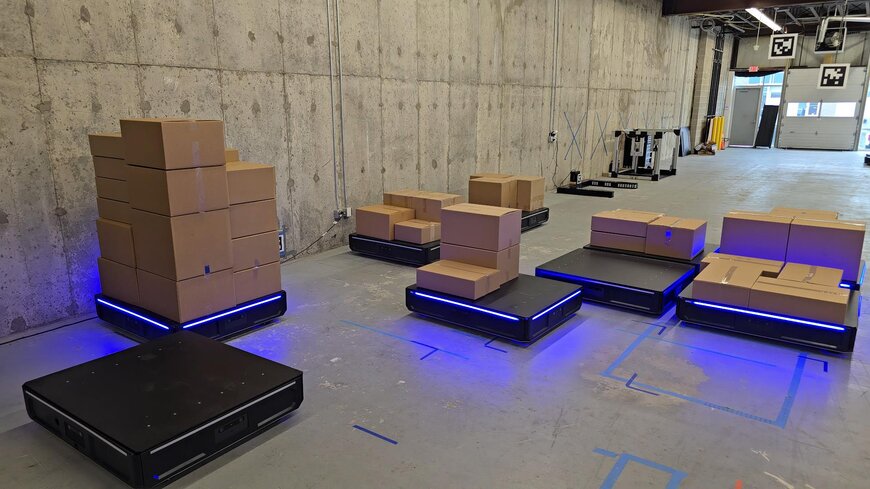
Logic Robotics has introduced the Logic Pallet, an autonomous mobile robot designed to automate the movement of palletized goods within and between logistics facilities. The system combines autonomous transport, warehouse orchestration, and inventory management to support warehouse automation in industries including consumer goods, food distribution, government logistics, and manufacturing.
Autonomous Mobile Robot for Material Handling
The adoption of autonomous mobile robots continues to increase as warehouse operators seek higher throughput, improved storage utilization, and reduced dependence on manual material handling. The Logic Pallet has been developed as a robotic alternative to conventional pallets and forklifts by integrating transport, storage, and inventory functions into a single autonomous platform.
The 48 × 40 in. mobile pallet is manufactured in the United States and is designed for transporting boxed consumer goods and food products. It supports payloads of up to 2,000 lb (907 kg), operates for up to 160 hours on a single battery cycle, and autonomously moves goods from their point of origin to vehicle transloading without requiring forklift intervention.
AI-Based Warehouse Orchestration
The robotic platform functions as a self-driving, self-loading, and self-unloading system capable of transporting standard-sized pallets between receiving, storage, picking, and retrieval locations. Warehouse operations are coordinated through LINK, Logic Robotics' AI-based warehouse operating system, which performs mission planning, path optimization, and storage allocation while adapting to changing warehouse conditions in real time.
According to the company, the autonomous platform enables continuous movement of goods with minimal operator intervention while coordinating multiple warehouse processes through a single software environment.
Storage Density and Inventory Management
The Logic Pallet supports aisleless warehouse layouts that can increase storage density by up to three times compared with conventional warehouse configurations. The platform travels at speeds of up to 2.2 mph (1 m/s), providing continuous transport between storage locations and workstations.
Inventory management is integrated into the platform through a patented weight-based monitoring system and automated item recognition. These functions enable on-demand cycle counting and real-time inventory visibility while reducing manual stock verification and inventory errors.
Applications in Warehouse and Supply Chain Operations
The autonomous mobile pallet is designed to automate logistics processes including consolidation, deconsolidation, cross-docking, goods-to-person picking, and trailer loading. Additional functions such as autonomous stacking and pallet return for reuse are intended to reduce operational downtime and improve equipment utilization.
Logic Robotics states that the system can load or unload a full trailer in approximately five minutes, contributing to shorter dock-to-stock times in warehouse and distribution operations. The platform is intended for applications requiring high-volume pallet handling across multiple facilities.
Additional Context: This section details technical specifications and competitive benchmarking not included in the original product announcement
The Logic Pallet differs from conventional autonomous mobile robot (AMR) solutions by integrating the robotic drive system directly into the pallet rather than transporting standard pallets with separate mobile robots. This design enables the same platform to transport, store, and transfer loads throughout warehouse operations.
Comparable warehouse automation technologies include the MiR1350 Pallet Jack from Mobile Industrial Robots, OTTO Motors autonomous transport vehicles, and Geek+ pallet-moving AMRs. These systems are designed to automate pallet transport but typically move existing pallets instead of functioning as the pallet itself. Automated storage and retrieval systems (AS/RS) from suppliers such as AutoStore and Swisslog also address warehouse automation but rely on fixed storage infrastructure rather than autonomous mobile platforms.
Published specifications for the Logic Pallet include a payload capacity of 2,000 lb (907 kg), a travel speed of 2.2 mph (1 m/s), battery life of up to 160 hours, AI-based fleet orchestration through the LINK operating system, and a patented weight-based inventory management system. Common benchmarking criteria across the warehouse automation sector include payload capacity, navigation capability, fleet management, warehouse integration, storage density, and inventory visibility, all of which are addressed by the Logic Robotics platform.
Edited by Sucithra Mani, Induportals Editor – Adapted by AI.
www.logic-os.com
