
www.intralogisticsmag.com
22
'26
Written on Modified on
Automated Intralogistics Architecture for Industrial Distribution
Jungheinrich and Eisenhart Laeppché have deployed an integrated material handling framework in Wilhelmshaven to automate small-parts and pallet storage.
www.jungheinrich.co.uk
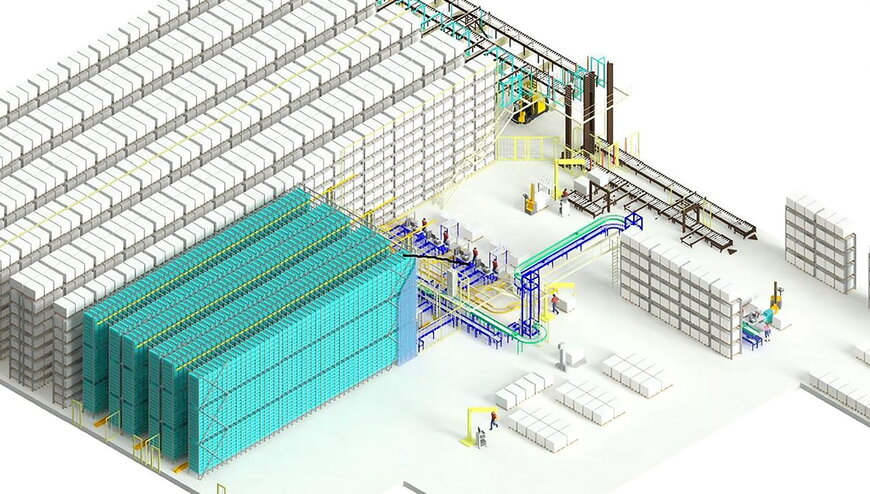
Eisenhart Laeppché GmbH collaborated with Jungheinrich to construct a greenfield distribution center in Wilhelmshaven, replacing manual order picking processes that had reached operational capacity limits due to expanding order volumes. Jungheinrich served as the primary system integrator, engineering and implementing a complete intralogistics system to increase throughput density and establish scalable industrial automation.
System Architecture and Technical Implementation
The installation combines an automated miniload warehouse and an automated very narrow aisle pallet warehouse, coordinated through a central control unit and software layer.
The automated miniload warehouse features 14,904 container storage locations arranged in double-deep configurations. Material transport within this section is executed by three STC 2B1A stacker cranes optimized for dynamic travel speeds and energy recovery during braking cycles.
Complementing the container storage, the automated pallet storage section utilizes a very narrow aisle layout providing 3,870 pallet locations within a 9.7-meter clear-height structure. Operations are conducted using two automated EKX 516ka narrow-aisle guided vehicles. System routing and stock management across both areas are governed by the Jungheinrich Warehouse Management System (WMS), integrated with a real-time visualization layer to supervise continuous material transport across container and pallet conveyor networks.
Process Engineering and Expansion Capacity
To optimize manual interactions, the facility incorporates six workstation modules designed according to the goods-to-person principle—four assigned to container picking and two to pallet processing. This configuration minimizes manual travel time, reduces material handling cycles, and shortens operational lead times.
"Given our growth, we were reaching the economic and organisational limits of our previous manual order picking. The new automated solution gives us considerably more efficient processes, creates additional capacity, noticeably shortens lead times and at the same time improves working conditions for our employees," says Hendrik Laeppché, Managing Director of Eisenhart Laeppché GmbH.
The facility's structural design accounts for future throughput requirements. The miniload section provides space for two additional storage aisles, while the high-bay pallet sector supports expansion for up to three additional EKX 516ka guided vehicles without altering the core control architecture.
Edited by Evgeny Churilov, Induportals Media - Adapted by AI.
www.jungheinrich.com
