
www.intralogisticsmag.com
23
'26
Written on Modified on
Edge AI Computer for Autonomous Mobile Robots
NEXCOM NDiS B364 Duro Edge computer runs onboard AI inference and sensor processing for AMR fleets in factories and warehouses.
www.nexcom.com
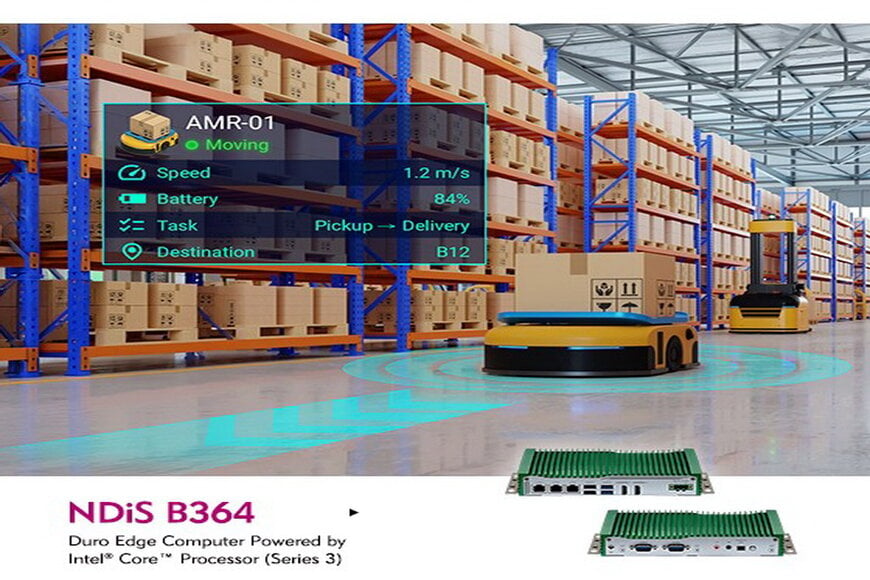
Labour shortages, rising e-commerce volumes and workplace safety requirements are pushing factories and warehouses towards autonomous mobile robots (AMRs). Each AMR needs an onboard computer that can process camera and LiDAR data in real time while drawing little power from the vehicle battery.
Why AMRs need edge AI computing
Unlike automated guided vehicles (AGVs), which follow fixed paths, AMRs use onboard sensors and AI to map their surroundings, detect obstacles and plan routes on their own. This shifts the computing workload onto the vehicle, where object recognition, image analysis and obstacle detection must run with low latency and a limited energy budget. According to NEXCOM, the AMR market is expected to reach USD 21.4 billion by 2033.
NEXCOM developed the NDiS B364 Duro Edge computer for this application. The fanless box PC runs on Intel Core 7, Core 5 or Core 3 processors (Series 3) with integrated NPUs for AI inference. A 12 V to 24 V DC input and an operating range of -20 °C to 60 °C allow installation in demanding industrial environments.
How the AI processing architecture works
The Series 3 processors, based on the Wildcat Lake architecture, distribute AI workloads across three engines: an Xe3 GPU with 18 TOPS, an NPU with 18 TOPS and the CPU with 5 TOPS, for a combined total of up to 41 TOPS. NEXCOM states that this nearly doubles the 22.5 TOPS of the previous Arrow Lake platform, while the Xe3 GPU alone delivers more than 1.5 times the graphics performance of its predecessor.
Offloading continuous, low-power inference tasks such as image analysis and obstacle detection to the NPU keeps the CPU free for control logic and limits energy consumption, which directly affects AMR runtime per battery charge.
I/O tailored to AMR vehicle integration
The interface layout follows the typical AMR system architecture. Two USB 3.2 ports connect 3D cameras, and two HDMI 1.4 outputs support operational monitors at up to 4096 x 2160 at 30 Hz. RS-422/485 serial interfaces link the computer to motor drivers and the battery management system (BMS), so operators can track battery status and plan recharging. GPIO handles status inputs and alert outputs for obstacle warnings and real-time power status.
Three Intel LAN ports (two 2.5GbE and one 1GbE) provide the bandwidth for 3D LiDAR sensors used in environmental scanning, obstacle detection and path planning. An M.2 Key B socket accepts an optional 5G/LTE module and an M.2 Key E socket an optional Wi-Fi module. These wireless links connect AMRs to fleet dispatch systems, warehouse management systems (WMS) and remote monitoring platforms for status reporting and OTA updates. The Key E socket can alternatively host a third-party CAN FD module. The default line-out can be converted to speaker-out for voice announcements and audio alerts in noisy halls.
Technical specifications
The system supports one DDR5-6400 SO-DIMM with up to 64 GB, an M.2 Key M 2242 slot for an optional PCIe 4.0 SSD, TPM 2.0 for security and Intel ISM technology. Three variants are available: NDiS B364-350 with Core 7 processor 350, NDiS B364-320 with Core 5 processor 320 and NDiS B364-304 with Core 3 processor 304.
Safety in shared industrial workspaces
Heavy machinery and long transport routes expose workers to risk. AMRs that take over repetitive material transport reduce the time people spend in these areas and let staff focus on planning and analysis. Onboard sensing and obstacle detection, supported by the computing and connectivity of the NDiS B364, allow the vehicles to react to changing conditions in dynamic environments.
Additional Context
This section details technical specifications and competitive benchmarking not included in the original product announcement.
Intel launched the Core Series 3 family, codenamed Wildcat Lake, in April 2026 for entry-level laptops and edge AI systems. Its compute tile is manufactured on the Intel 18A process, with up to two performance cores and four low-power efficient cores, up to two Xe3 GPU cores and a base power of 15 W. Intel positions the family for robotics, smart buildings and point-of-sale systems. In its own benchmarks, Intel compared the Core 7 350 with the NVIDIA Jetson Orin Nano, a widely used module in mobile robotics, and reported up to 1.5 times higher object detection and up to 2.2 times higher video analytics performance. These figures are vendor-published and depend on the workload and software stack used.
Edited by Evgeny Churilov, Induportals Media - Adapted by AI.
www.nexcom.com
