
www.intralogisticsmag.com
11
'26
Written on Modified on
NXP Launches UCODE Nxm RAIN RFID Chip with Extended Memory
NXP Semiconductors has introduced UCODE Nxm, a flexible RAIN RFID integrated circuit featuring 880 bits of configurable memory for data-rich applications.
www.nxp.com
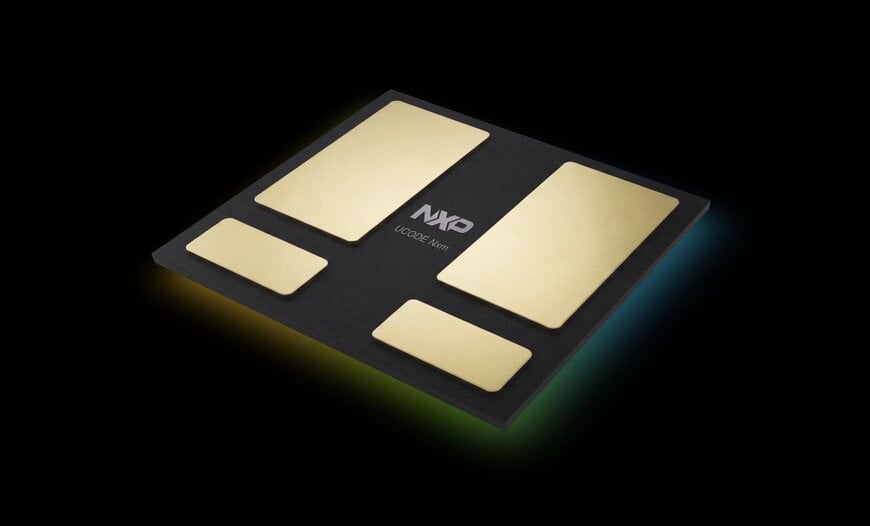
NXP Semiconductors has introduced UCODE Nxm, a high-capacity RAIN RFID integrated circuit designed for data-rich tracking, traceability, and Digital Product Passport (DPP) applications. The chip enables products to store extended operational records, status updates, and lifecycle data directly on tag memory.
Data-Rich RAIN RFID Memory Requirements
Conventional RAIN RFID applications rely on serial number identification, but modern automation, traceability, and consumer engagement workflows demand richer item-level data storage. On-chip extended memory allows tagged products to maintain localized data records that remain readable and updateable as items progress through supply chains or when network connectivity is unavailable. Single RAIN RFID readers can process hundreds of thousands of tagged items per hour, supporting high-speed inventory management, real-time asset tracking, and hands-free automation.
Emerging regulatory requirements, including European Union mandates for Digital Product Passports, require products to carry accessible lifecycle and sustainability data. In addition, brands utilize on-tag memory to transform physical goods into interactive touchpoints, enabling consumers to verify product authenticity, origin, and sustainability parameters.
Configurable Memory Architecture and Security Features
UCODE Nxm features 880 bits of total memory that designers can allocate between the Electronic Product Code (EPC) and user memory banks. The chip provides three selectable memory configurations determined at encoding, offering up to 496 bits of EPC memory or up to 752 bits of user memory. This single-chip configurable structure allows one part number to support diverse application requirements without requiring multiple stock keeping units (SKUs).
Data integrity and privacy are managed through embedded hardware features. UCODE Nxm incorporates Memory Safeguard technology, which utilizes Error Correction Code (ECC) to detect and correct bit errors. The integrated circuit also implements standards-based Untraceable privacy functions to mask sensitive memory fields on demand. RF performance is supported by a read sensitivity of -24 dBm combined with NXP's integrated Self-Adjust feature for operation in harsh radio frequency environments.
Application Scope Across Industrial and Commercial Sectors
The extended memory capabilities of UCODE Nxm address operational requirements across multiple sectors:
- Industrial Manufacturing and Industry 4.0: Enables engineering teams to determine product build parameters and process status directly from the tag during assembly.
- Healthcare and Pharmaceuticals: Allows healthcare technicians to read expiration dates, lot numbers, and handling instructions at the point of care.
- Asset and Container Management: Supports tracking of container ownership, location, dwell time, and loss metrics.
- Supply Chain Visibility: Confirms item dispatch and receipt across logistics hubs.
Additional Context
This section details technical specifications not included in the original news release.
RAIN RFID operates in the Ultra-High Frequency (UHF) spectrum between 860 MHz and 960 MHz, governed globally by the GS1 EPC Gen2v2 (ISO/IEC 18000-63) air-interface protocol. The memory structure of Gen2v2-compliant integrated circuits is divided into four distinct logical memory banks: Reserved (containing kill and access passwords), EPC (holding the Electronic Product Code and control bits), TID (Tag Identifier containing factory-locked unique chip identification and model codes), and User memory.
In high-density passive RFID deployments, signal integrity and data retention face degradation from electromagnetic interference (EMI), multipath fading, and dielectric loading caused by adjacent metals or liquids. Error Correction Code (ECC) algorithms operating on-chip utilize Hamming codes or cyclic redundancy checks to automatically reconstruct corrupted bit cells caused by cosmic radiation, static discharges, or marginal read/write power levels.
The GS1 EPC Gen2v2 Untraceable command allows authorized readers to dynamically restrict tag visibility and alter read ranges during consumer interaction or post-sale lifecycle phases. By masking specific memory banks (such as EPC or User memory) or truncating the transmitted EPC length without physically destroying the tag via a kill command, the integrated circuit enforces privacy protections while maintaining future re-readability for recycling or Digital Product Passport verification systems.
Edited by Romila DSilva, Induportals Editor, with AI assistance.
This section details technical specifications not included in the original news release.
RAIN RFID operates in the Ultra-High Frequency (UHF) spectrum between 860 MHz and 960 MHz, governed globally by the GS1 EPC Gen2v2 (ISO/IEC 18000-63) air-interface protocol. The memory structure of Gen2v2-compliant integrated circuits is divided into four distinct logical memory banks: Reserved (containing kill and access passwords), EPC (holding the Electronic Product Code and control bits), TID (Tag Identifier containing factory-locked unique chip identification and model codes), and User memory.
In high-density passive RFID deployments, signal integrity and data retention face degradation from electromagnetic interference (EMI), multipath fading, and dielectric loading caused by adjacent metals or liquids. Error Correction Code (ECC) algorithms operating on-chip utilize Hamming codes or cyclic redundancy checks to automatically reconstruct corrupted bit cells caused by cosmic radiation, static discharges, or marginal read/write power levels.
The GS1 EPC Gen2v2 Untraceable command allows authorized readers to dynamically restrict tag visibility and alter read ranges during consumer interaction or post-sale lifecycle phases. By masking specific memory banks (such as EPC or User memory) or truncating the transmitted EPC length without physically destroying the tag via a kill command, the integrated circuit enforces privacy protections while maintaining future re-readability for recycling or Digital Product Passport verification systems.
Edited by Romila DSilva, Induportals Editor, with AI assistance.
