
www.intralogisticsmag.com
29
'26
Written on Modified on
Connecting Warehouse Management With Autonomous Robotics
Intel and SAP integrate edge AI with enterprise software to enable real-time coordination between warehouse systems and robotic fleets.
www.intel.com
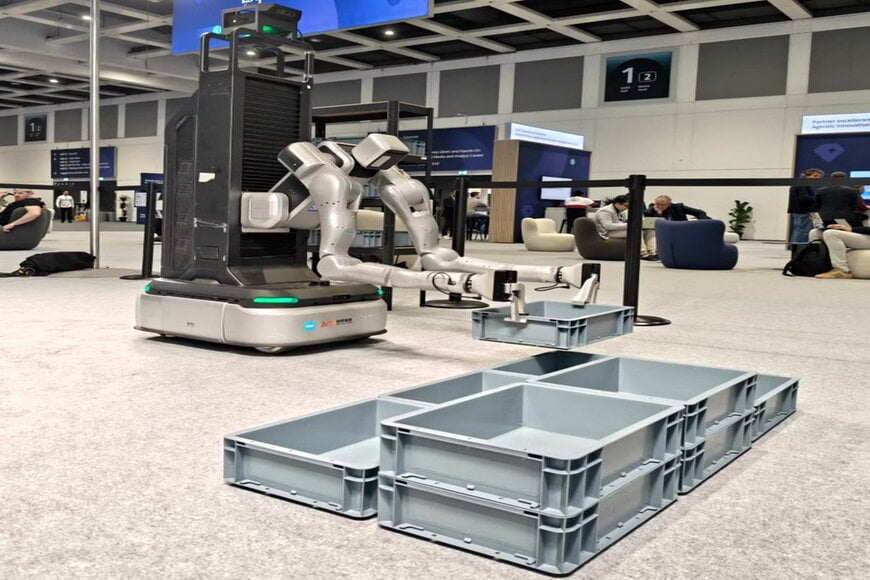
Intel and SAP SE developed a system architecture linking enterprise software to physical shop-floor machinery, establishing a bidirectional control loop between information technology and operational technology through edge-based machine learning.
Industrial Automation Integration Challenge
Industrial logistics facilities frequently operate enterprise planning tools separately from floor-level transport mechanisms. This division requires intermediate manual scheduling, which introduces latency and limits visibility when handling dynamic exceptions. Bridging enterprise systems with autonomous fleets demands real-time computational capacity at the edge to support simultaneous machine vision, path planning, and operational workflow orchestration without locking facilities into single-vendor robotics ecosystems.
Technical Roles and Edge Architecture
The integration connects SAP Extended Warehouse Management to Intel edge hardware running across mobile transport units. SAP Extended Warehouse Management governs high-level business logic, process rules, and inventory tracking. When material handling tasks are generated, the enterprise system dispatches work orders directly to autonomous mobile robots.
Intel provides the heterogeneous compute framework composed of central processing units, graphics processing units, and neural processing units operating locally on each robot. These onboard units run software tools, including the OpenVINO toolkit, Physical AI Studio, and Robotics AI Suite. Local processing handles computer vision, sensor fusion, spatial inference, and motion control, allowing machines to navigate facility floors autonomously while maintaining deterministic response times.
Closed-Loop Execution and Verification
The system was evaluated through a proof-of-concept deployment managing warehouse logistics. Within this implementation, high-level material transport requests were converted into decentralized robotic transit routines. As autonomous robots executed physical movement, task completion metrics, localized exceptions, and unit coordinates were continuously relayed back to the enterprise management layer. This data loop updated inventory records and triggered subsequent automated workflows without manual input.
The deployment demonstrated measurable operational changes, specifically lowering overall transport transit distance and decreasing manual handling cycles. By running runtime execution on an open computing architecture, the interface remains robot-agnostic. Industrial operators can deploy heterogeneous robotic fleets across different facilities while retaining centralized enterprise oversight.
Strategic Rationale
"By combining SAP’s enterprise context and orchestration with Intel’s edge AI and robotics technologies, we can help customers move Physical AI from business decision to real-world execution," said John Healy, Vice President and General Manager, Industrial and Robotics, Intel.
"SAP and Intel are creating solutions to help customers integrate AI-driven automation into core processes while preserving flexibility across robotics platforms, deployment models and ecosystem partners across both hardware and software," said Dr. Lukasz Ostrowski, Head of Physical AI and Robotics, SAP Research and Innovation, SAP SE.
The technical architecture provides a repeatable deployment model for logistics centers seeking automated material transit across multiple operational sites.
Edited by Evgeny Churilov, Induportals Media - Adapted by AI.
www.intel.com
