
www.intralogisticsmag.com
03
'26
Written on Modified on
Mecalux showcases warehouse automation & AI solutions at Retail Supply Chain & Logistics Expo 2026
Visitors can explore robotic storage systems, Easy WMS, AI-powered logistics tools and MIT research advancing warehouse optimisation and operational efficiency.
www.mecalux.com
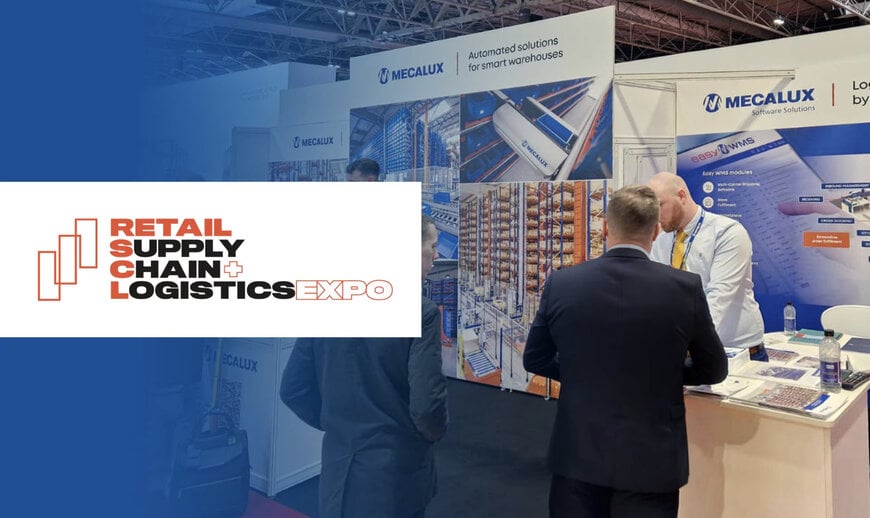
At Retail Supply Chain & Logistics Expo 2026, taking place on 11 and 12 November 2026 at ExCeL London, intralogistics provider Mecalux plans to present its integrated automated storage systems, autonomous mobile robotics, and warehouse management software. The exhibition focuses on distribution and fulfillment engineering innovations designed to resolve throughput and inventory control challenges across high-volume retail and e-commerce supply chains.
Core Technology and System Architecture
The exhibited hardware architecture centers on automated high-density storage and retrieval mechanisms, including the 4-Way Pallet Shuttle and shuttle-based automated storage and retrieval systems for containers. Goods-to-person configurations utilize autonomous shuttles that extract tote boxes from racking structures and transfer them directly to picking stations. At the control layer, the Easy WMS warehouse management system supervises material handling flows, maintains real-time inventory synchronization, and orchestrates equipment routing. The platform integrates natural-language processing alongside artificial intelligence agents designed to process operational telemetry, detect bottlenecks, and execute automated slotting adjustments.
Deployment or Implementation
The hardware and software architectures integrate with existing facility frameworks through standardized communication interfaces linking physical handling equipment, programmable logic controllers, and enterprise resource planning environments. Development and validation of these computational models involve collaborative engineering between Mecalux and the Massachusetts Institute of Technology. Through this partnership, computational digital twins and operational research simulations model facility kinematics, replenishment cadences, and warehouse slotting configurations prior to physical commissioning.
Industry Applications
The combined hardware and software architecture addresses distribution facilities characterized by high inventory complexity and fluctuating throughput rates. Primary target sectors include retail, consumer packaged goods, and omnichannel e-commerce fulfillment centers managing extensive stock keeping unit counts. Specific operational use cases involve high-density buffer storage, rapid split-case order retrieval, and dynamic goods consolidation, which eliminate manual travel paths and improve order fulfillment precision.
Operational Impact and Performance Metrics
By decoupling physical material movement from manual travel, autonomous shuttle mechanics and goods-to-person workflows establish continuous order retrieval cycles regardless of SKU variety. Systematic stock positioning coordinated by predictive algorithms optimizes travel trajectories, while automated buffer storage maximizes vertical volumetric utilization without structural facility expansion. Real-time telemetry monitoring through the software layer enables predictive anomaly detection, stabilizing warehouse throughput and maintaining fulfillment cycle times during peak demand surges.
Edited by Natania Lyngdoh, Induportals editor, with AI assistance.
www.mecalux.com
